Call us @+234 806 558 2598

Bad Bunny Redefines The Super Bowl 2026 Halftime Show With Lady Gaga And Ricky Martin

The Super Bowl 2026 halftime show marked a significant shift in how global culture is presented on American television. Headlined by Puerto Rican artist Bad Bunny, the performance at Super Bowl LX became the first in the event’s history to be led by a Latino solo act and delivered largely in Spanish. What followed was not just a musical spectacle, but a moment that triggered wide public discussion, political reaction and unexpected developments off the stage.
Held on 8 February 2026 at Levi’s Stadium in Santa Clara, California, the halftime show unfolded before a global audience running into the hundreds of millions. Bad Bunny, born Benito Antonio Martínez Ocasio, used the platform to present a performance rooted in Latin music, Caribbean identity and contemporary pop culture, departing from the English-dominant format traditionally associated with the Super Bowl.
The set opened with high-energy choreography and production design that reflected Latin American and Caribbean street culture. The visual themes referenced neighbourhood life, migration, celebration and community, all while maintaining the fast-paced spectacle expected of a Super Bowl audience. From the opening moments, it was clear that the performance was structured to centre identity rather than adapt to convention.
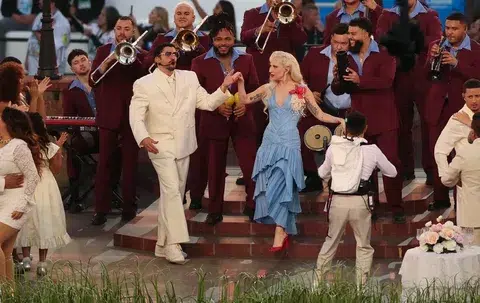
Bad Bunny’s song selection drew heavily from his catalogue that has defined his rise as one of the most commercially successful artists of the decade. The performance blended reggaeton, Latin trap and pop influences, delivered with live instrumentation and large-scale choreography. While the music itself drove the show, the guest appearances elevated it further and became some of the most talked-about moments of the night.
Midway through the performance, Lady Gaga made a surprise appearance, joining Bad Bunny on stage in a collaborative segment that fused Latin rhythms with pop vocal delivery. The pairing of the two artists was unexpected and drew immediate reaction from viewers across social media platforms. Gaga’s involvement added mainstream pop familiarity to a show that was otherwise firmly anchored in Latin sound and culture.
Ricky Martin later appeared during the set, reinforcing the generational reach of Latin pop on a stage that has historically prioritised American and British artists. His presence served as a symbolic bridge between earlier waves of Latin crossover success and Bad Bunny’s current global dominance. Together, the guest performances underscored the breadth of Latin influence in modern popular music.
The closing moments of the halftime show carried a more symbolic tone. As the final song ended, Bad Bunny was seen holding a football marked with the words “Together, We Are America”, while the stadium screens displayed a message centred on unity and rejection of hate. Performers held flags representing different countries across the Americas, bringing the show to a close with a visual statement rather than a musical climax.
Audience response to the performance was immediate and divided. Supporters praised the show as a landmark moment for representation, noting that Spanish-language music and Latino culture were placed at the centre of one of the most watched broadcasts in the world without compromise. Many highlighted Bad Bunny’s decision not to dilute his identity for broader appeal as a defining feature of the performance.
At the same time, the show drew sharp criticism from some quarters, particularly from conservative commentators and political figures. Former United States President Donald Trump was among those who publicly criticised the halftime performance. In posts shared on his social media platform shortly after the game, Trump described the show as “terrible” and questioned its suitability for a Super Bowl audience. He also criticised the language used during the performance, suggesting that it did not reflect what he viewed as American cultural standards.
Trump’s remarks quickly became part of the wider conversation surrounding the halftime show, with supporters echoing his views and critics pushing back against what they described as dismissive attitudes towards Latino culture and Spanish-speaking Americans. The criticism did not reference any breach of broadcast rules or performance guidelines, focusing instead on personal and cultural objections.
Other public figures also weighed in. Influencer Jake Paul made comments questioning Bad Bunny’s American identity, statements that were later challenged publicly, particularly in light of Puerto Rico’s political status and citizenship laws. The comments drew criticism and prompted clarification from multiple sources, reinforcing that Puerto Ricans are United States citizens by birth.
On the opposite side of the political spectrum, Democratic figures and cultural commentators praised the performance for reflecting the diversity of modern America. California Governor Gavin Newsom publicly commended the show, describing it as expressive and culturally significant. These contrasting reactions illustrated how the halftime performance became a focal point for broader cultural and political debates.
Beyond the immediate reactions, another development added to the attention surrounding Bad Bunny in the hours following the Super Bowl. Shortly after the performance ended, fans noticed that the artist had removed all posts from his Instagram account. His profile picture was deleted, and he unfollowed every account, leaving only a link to his most recent album in his bio.
The sudden removal of content from an account followed by tens of millions of users sparked widespread speculation. Some interpreted the move as a response to criticism and backlash, while others pointed to Bad Bunny’s history of clearing his social media during transitional moments in his career. The artist and his representatives did not issue any statement explaining the decision at the time of reporting.
Despite the speculation, the Instagram reset did not impact Bad Bunny’s visibility or reach. His follower count remained unchanged, and discussion around the halftime show continued to dominate entertainment news cycles in the days following the Super Bowl. Analysts noted that the move may have functioned as a form of controlled silence, allowing the performance itself to remain the central focus.
From an industry perspective, the Super Bowl 2026 halftime show represented a recalibration of what is considered mainstream entertainment. Bad Bunny’s headlining role reflected shifting demographics, global streaming trends and the increasing influence of non-English music in international markets. His selection by the NFL and its broadcast partners signalled recognition of these changes rather than a temporary experiment.
The commercial implications were also significant. Music streaming numbers for Bad Bunny’s catalogue reportedly surged following the performance, and interest in Latin artists featured during the show increased across digital platforms. While the NFL did not release detailed metrics immediately, early indicators suggested that the halftime show achieved strong engagement across age groups and regions.
In retrospect, the Super Bowl 2026 halftime show will likely be remembered less for its setlist and more for what it represented. It challenged expectations, sparked political reaction, and demonstrated the cultural reach of an artist who has consistently resisted traditional industry norms. Whether viewed as groundbreaking or controversial, Bad Bunny’s performance altered the conversation around representation on one of the world’s largest stages.
As debates continue and analysis evolves, the halftime show stands as a defining moment in the ongoing intersection of music, identity and mass entertainment. It confirmed that the Super Bowl, long seen as a mirror of American pop culture, is increasingly reflecting a broader and more complex global audience.

