Call us @+234 806 558 2598

Gabon Shuts Down Social Media: Indefinite Suspension Amid Rising Civil Unrest

On the 18th of February 2026, the digital landscape of Gabon was abruptly altered as the nation’s media regulator, the High Authority for Communication (HAC), announced a nationwide and indefinite suspension of social media platforms. This move, which took effect immediately, has plunged the Central African nation into a state of digital isolation, echoing past instances of information control while raising fresh concerns about the trajectory of democratic freedoms under the current administration. The suspension was not merely a technical glitch but a calculated state intervention, framed as a necessity for national security and the preservation of social cohesion.
The directive was delivered via a televised statement on Tuesday evening by Jean-Claude Mendome, the spokesperson for the HAC. In his address, Mendome articulated a series of grievances that the government holds against digital platforms. The primary justifications cited were the spread of “false information,” “coordinated cyberbullying”, and the “unauthorised disclosure of personal data.” According to the regulator, these activities had reached a threshold that threatened the stability of the Republic’s institutions and the honour of its citizens.
The language used in the announcement was notably severe. The HAC described online content as “inappropriate, defamatory, hateful, and insulting,” claiming that such material was undermining “human dignity, public morality, and social cohesion.” By invoking the 2016 Communications Code, the authorities provided a legal veneer for a move that many critics have branded as a blunt instrument of censorship. The regulator instructed all telecommunications operators and internet service providers within Gabon to block access to major platforms, a task that was carried out with swift efficiency.
Platforms Affected And The Extent Of The Blackout
By Wednesday morning, the 19th of February 2026, reports from ground observers and international journalists confirmed the scale of the disruption. Journalists from Agence France-Presse (AFP) noted that major services including Facebook and TikTok were no longer accessible through standard connections. Connectivity monitors, such as NetBlocks, corroborated these reports, showing significant restrictions across a suite of popular applications.
The blackout is comprehensive, affecting not only social networking sites but also essential communication tools. The list of restricted platforms includes:
- Facebook and Instagram: Used widely for both social interaction and digital marketing.
- TikTok: A primary source of news and entertainment for the younger Gabonese demographic.
- WhatsApp: The country’s most popular messaging service, essential for personal and business communication.
- YouTube: Restricted, limiting access to video content and independent news broadcasts.
According to technical data, while some limited connectivity remained through Gabon Telecom, the majority of the nation’s 850,000 active social media users found themselves unable to refresh their feeds or send messages. This represents roughly one-third of Gabon’s total population of 2.5 million, illustrating the profound reach of the suspension.
The Socio-Political Context: Labour Strikes And Public Discontent
The decision to shut down social media did not occur in a vacuum. It coincides with a period of mounting social pressure and industrial action that has been building since late 2025. President Brice Oligui Nguema, who transitioned from military leader to elected president following the 2025 elections, is currently facing his most significant challenge since taking power.
The core of the unrest lies in a prolonged dispute with public sector workers. School teachers began a high-profile strike in December 2025, protesting against poor pay, inadequate working conditions, and a decade-long wage freeze that was initially implemented by the previous administration. What began as a local education strike has since metastasised into a broader movement of public sector discontent. Workers in the health, higher education, and broadcasting sectors have either joined the strike or threatened to down tools in solidarity.
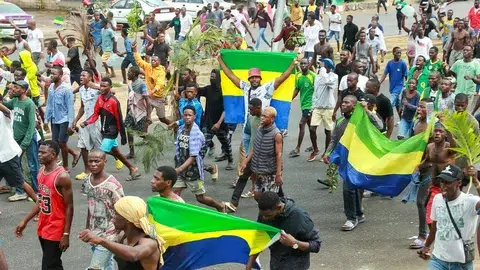
For the government, social media platforms are viewed as the primary engine for organising these protests and disseminating anti-government sentiment. By cutting off the digital town square, the administration appears to be attempting to fragment the opposition and dampen the visibility of the strikes. Critics, including opposition leader Alain-Claude Billie-By-Nze, have argued that the move creates a “climate of fear and repression,” aimed at silencing legitimate grievances through digital force.+1
The Irony Of Digital Restoration And New Restrictions
The current shutdown is particularly striking given the historical context of President Nguema’s rise to power. Following the August 2023 coup that ended the 56-year rule of the Bongo family, one of Nguema’s first acts was to restore the internet services that had been cut by the ousted regime. At that time, the restoration was hailed as a return to transparency and a commitment to modern democratic values.
However, the 2026 suspension suggests a return to the very tactics Nguema once replaced. After winning the 2025 presidential election with over 90% of the vote, a margin that critics say was bolstered by the exclusion of key opposition figures, the administration has pivoted toward more restrictive measures. This shift highlights a recurring theme in regional politics, where digital connectivity is embraced when it serves the transition of power but is curtailed when it facilitates dissent against the new establishment.
Economic Consequences Of A Digital Silence
The economic impact of an indefinite social media suspension in Gabon is likely to be severe. In the modern economy, social media is not just a tool for leisure but a vital infrastructure for commerce. An estimated 850,000 users in Gabon rely on these platforms for small business sales, digital marketing, and customer service.
Local entrepreneurs have already begun to express their despair. In Libreville, restaurant owners and boutique managers who rely on WhatsApp and Facebook for roughly 40% of their customer engagement are seeing their sales pipelines vanish overnight. The suspension disrupts the “informal” digital economy, which is a lifeline for many young Gabonese citizens. Beyond individual businesses, the uncertainty created by such a move can deter foreign investment and damage the nation’s reputation as a stable environment for digital trade. Estimates from digital rights groups suggest that internet-related disruptions can cost the Gabonese economy millions of pounds for every day they remain in place.
Comparison With Regional Digital Censorship Trends
Gabon is not alone in its use of digital “kill switches” to manage political crises. The 2026 shutdown follows a broader pattern across the African continent:
- Tanzania: Restricted nationwide internet access during the 2025 general elections.
- Nigeria: Famously suspended X (formerly Twitter) for seven months in 2021.
- Uganda: Implemented comprehensive blackouts surrounding its most recent general elections.
These incidents are often justified by governments under the guise of national security or the prevention of “fake news.” However, international bodies such as UNESCO and various human rights organisations argue that such measures are disproportionate and violate the fundamental right to information. In the case of Gabon, the HAC continues to insist that freedom of expression remains a protected right, despite the physical inability of citizens to express themselves on the platforms they use most.+2
The Legal Framework: The 2016 Communications Code
The government’s legal justification rests on the 2016 Communications Code, a piece of legislation that grants the state broad powers to regulate media in the interest of public order. By citing “cyberbullying” and the “unauthorised sharing of personal data”, the HAC is leveraging genuine digital concerns to justify a total shutdown. While cyberbullying is a legitimate social issue, digital rights advocates point out that existing laws and platform-level moderation are the appropriate tools for addressal, rather than the wholesale disconnection of the population.
The lack of a defined end date for the suspension adds to the atmosphere of uncertainty. Unlike previous “digital curfews” that were limited to specific hours or election days, the 2026 blackout is open-ended. This suggests that the government may not restore access until the current wave of labour strikes has been fully suppressed or resolved on the state’s terms.
The indefinite suspension of social media in Gabon marks a pivotal moment in the nation’s post-coup history. It serves as a stark reminder that digital rights are often fragile and subject to the political winds of the day. As the strikes continue and the digital blackout persists, the international community will be watching closely to see how the Gabonese government balances its security concerns with its stated commitment to democratic progress.
For the people of Gabon, the loss of social media is a loss of their most effective tool for accountability. Without the ability to share information in real-time, the narrative of the country’s progress is once again left entirely in the hands of state-controlled media. Whether this move will successfully “restore order” or simply deepen the divisions it seeks to mend remains to be seen.