Call us @+234 806 558 2598

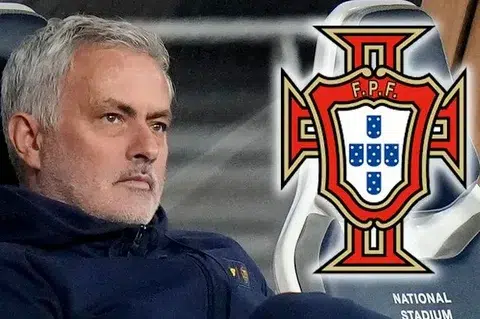
José Mourinho Emerges As Leading Candidate For Portugal Job After 2026 World Cup

Portugal’s football federation is expected to review its national team leadership after the 2026 FIFA World Cup, with José Mourinho emerging as a leading candidate to be offered the role, according to widespread reporting and long-standing public indications of interest from both sides.
While no formal appointment process has begun and no official offer has been confirmed, multiple factors have placed Mourinho at the centre of discussions around Portugal’s post-2026 future. These include the end of the current managerial cycle, Mourinho’s career trajectory, and the federation’s long-term planning around leadership, identity, and tournament management.
The Current Situation With Portugal’s National Team
Portugal are currently managed by Roberto Martínez, who was appointed in January 2023 following the departure of Fernando Santos after the 2022 World Cup. Martínez signed a contract that runs through the 2026 World Cup in the United States, Canada, and Mexico.
Under Martínez, Portugal have undergone a tactical reset, moving away from the conservative approach that characterised the latter stages of Santos’ tenure. The squad remains one of the most talented in international football, with players such as Bruno Fernandes, Bernardo Silva, João Cancelo, Rúben Dias, Rafael Leão, and João Félix forming the core of the team.
Cristiano Ronaldo remains part of the setup, although his role has evolved as Portugal look to balance experience with generational renewal.
The Portuguese Football Federation has made clear that Martínez’s mandate is centred on the 2026 World Cup, after which a full review of the national team programme is expected, regardless of tournament outcome.
Why the 2026 World Cup Is a Natural Transition Point
International football operates in defined cycles, with World Cups often serving as endpoints for managerial tenures. Portugal are no exception. The 2026 tournament will mark nearly a decade of generational transition since the Euro 2016 triumph, and the federation is expected to reassess leadership with an eye on Euro 2028 and the next phase of player development.
Martínez’s contract structure aligns with this timeline, making the post-2026 period a natural opening for change. This context has fuelled speculation around potential successors, with Mourinho consistently mentioned due to his stature, nationality, and experience.
José Mourinho’s Long-Standing Link to the Portugal Job
José Mourinho has never managed a national team, but he has repeatedly spoken about his desire to coach Portugal at some point in his career. He has described the role as a “dream” and has stated publicly that managing his country would represent a different kind of professional fulfilment compared to club football.
Mourinho’s name has been linked to the Portugal job on several occasions, including after Euro 2016, the 2018 World Cup, and the 2022 World Cup. On each occasion, timing, contractual obligations, or federation strategy prevented serious negotiations.
The post-2026 window is viewed by many observers as the most realistic opportunity yet, as Mourinho would be approaching the latter stages of his coaching career and may be more open to a national team role that offers reduced day-to-day intensity compared to club management.
Mourinho’s Managerial Profile and Suitability
Mourinho is one of the most decorated managers in football history. He has won league titles in Portugal, England, Italy, and Spain, as well as multiple European trophies, including the UEFA Champions League with Porto and Inter Milan, the UEFA Europa League with Porto and Manchester United, and the UEFA Europa Conference League with Roma.
His reputation has been built on tactical discipline, tournament management, and psychological control of high-pressure environments. These qualities are often cited as particularly valuable in international football, where preparation time is limited and knockout matches define success.
Portugal’s squad profile, filled with technically gifted players accustomed to elite competition, aligns with Mourinho’s preference for experienced, tactically intelligent footballers. Supporters of the idea argue that his pragmatic approach could provide balance to a team that has sometimes struggled to convert talent into consistent tournament success.
Relationship With Key Portuguese Figures
Mourinho maintains strong ties within Portuguese football. He began his coaching career at Benfica and rose to prominence with Porto, where he achieved historic success before moving abroad.
Several senior figures within the Portuguese Football Federation have worked with or closely followed Mourinho’s career, and his status as one of Portugal’s most successful football exports gives him significant cultural authority within the game.
Players such as Pepe, who previously worked with Mourinho at Real Madrid, and others who have played under managers influenced by his methods, are familiar with his style. While Mourinho’s relationship with Cristiano Ronaldo has not been direct at club level, he has consistently spoken positively about Ronaldo’s professionalism and influence.
Potential Challenges of a Mourinho Appointment
Despite his achievements, a Mourinho appointment would not be without risk. His confrontational style, media management approach, and tendency toward defensive football have divided opinion in recent years.
International management requires a different communication dynamic, particularly when dealing with players who spend most of the year under different club systems. Managing egos, expectations, and limited training windows can test even the most experienced coaches.
There is also the question of long-term development. National team coaches are increasingly expected to integrate youth pathways and align with federation-wide football philosophies. Mourinho’s focus has traditionally been short-to-medium-term success rather than structural development.
The Federation’s Strategic Considerations
The Portuguese Football Federation has increasingly emphasised planning, continuity, and institutional alignment. Any post-2026 appointment is likely to be evaluated against these criteria rather than reputation alone.
Decision-makers will assess whether Mourinho’s leadership style aligns with broader goals such as youth integration, tactical modernisation, and international competitiveness beyond a single tournament cycle.
Financial considerations also play a role. Mourinho remains one of the highest-profile managers in the game, and his salary expectations would exceed those of many national team coaches. However, the commercial and symbolic value of appointing a figure of his stature could offset those costs.
What Mourinho Has Said About International Management
Mourinho has stated that he would only accept a national team job under the right circumstances. He has emphasised the importance of timing, project clarity, and emotional connection.
In interviews, he has suggested that managing Portugal would require full commitment and respect for the role, not a semi-retirement from club football. This framing suggests that if he were to accept the position, it would be a deliberate and carefully planned decision rather than a symbolic appointment.
What Happens Next
At present, Roberto Martínez remains firmly in charge, with no indication that his position will be reviewed before the 2026 World Cup. Any discussion of Mourinho is centred on long-term planning rather than immediate change.
The Portuguese Football Federation is expected to conduct internal evaluations closer to the end of the 2026 cycle, factoring in tournament performance, squad development, and broader strategic objectives.
If Mourinho is formally approached, it would likely occur after the World Cup, allowing both parties to assess readiness, expectations, and feasibility without disrupting the current setup.
Outlook
The prospect of José Mourinho leading Portugal after the 2026 World Cup reflects a convergence of timing, ambition, and national identity. While no appointment has been confirmed, the conditions that previously made such a move unlikely have shifted.
Whether the federation ultimately chooses Mourinho or opts for a different direction will depend on performance, philosophy, and long-term vision. What is clear is that Portugal’s post-2026 future is already being shaped, and Mourinho’s name remains central to that conversation.
For now, the focus remains on the present cycle. The decisions that follow the 2026 World Cup will determine whether one of football’s most successful managers finally takes charge of his national team.

